Apple announced the iPhone 18 Pro and iPhone 18 Pro Max on September 9, 2026, with pre-orders opening September 12 and phones shipping September 18 in more than 65 countries and regions. The hardware is identical everywhere — a 2nm A20 Pro chip, a more efficient C2 modem, larger batteries, and a variable-aperture main camera on at least one Pro model. The price is not identical everywhere, and the gap between the cheapest and most expensive market is larger than most buyers expect.
Official iPhone 18 Pro Max Prices (256GB), by Country
- •United States: $1,299
- •Hong Kong: HK$11,499 (≈ $1,474)
- •United Arab Emirates: AED 5,499 (≈ $1,498)
- •Mainland China: CNY 10,999 (≈ $1,530)
- •Singapore: S$2,099 (≈ $1,566)
- •Japan: ¥239,800 (≈ $1,610)
- •India: ₹1,79,900 (≈ $2,044)
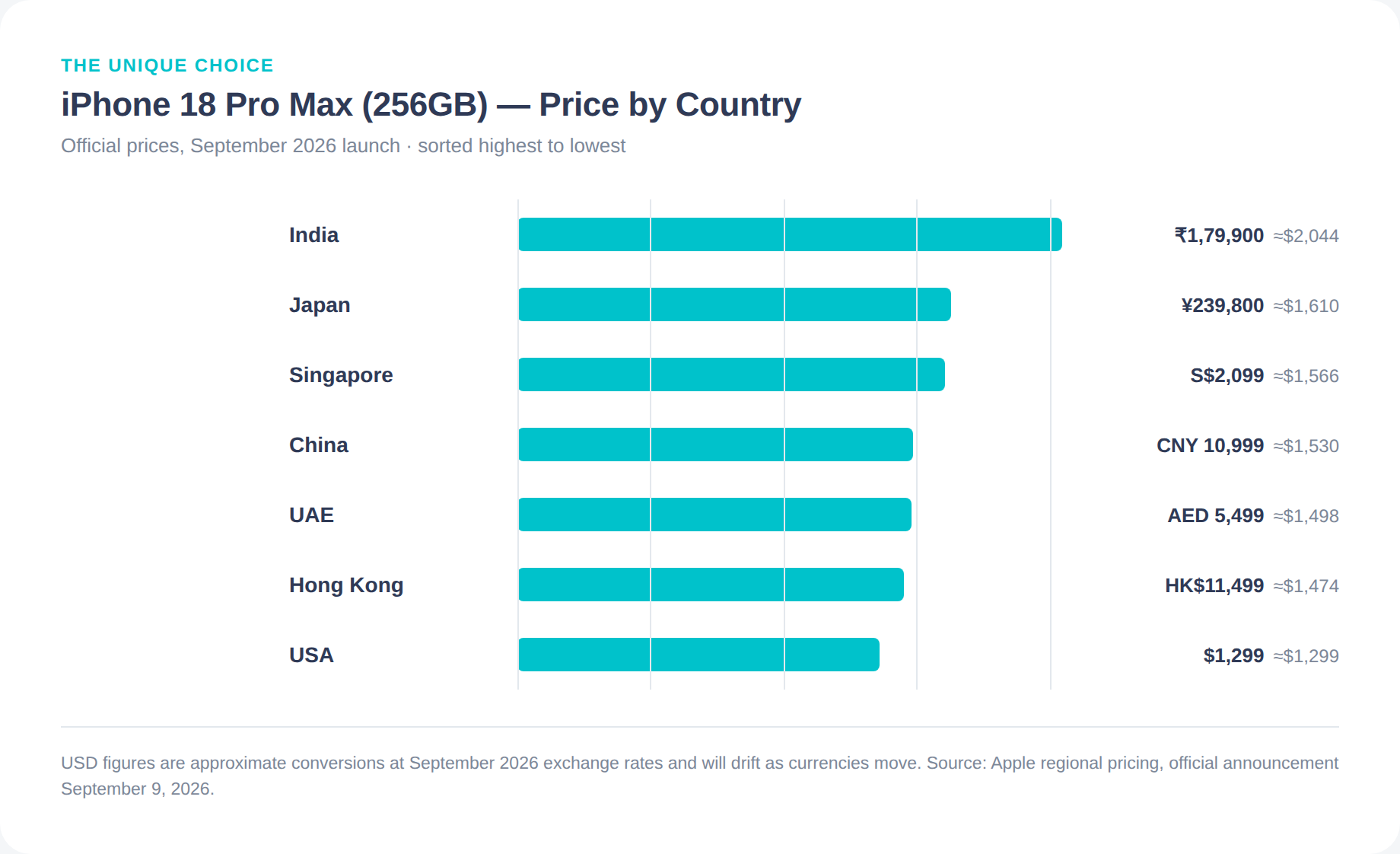
USD equivalents above are approximate, calculated from September 2026 exchange rates — they'll drift as currencies move, so treat them as a rough comparison rather than an exact quote. Even with that caveat, the pattern is stark: the same 256GB iPhone 18 Pro Max costs roughly 57% more in India than in the US, and about 39% more than in Hong Kong.
Why Are the Prices So Different?
Apple doesn't set wildly different factory prices by country — the gap is almost entirely each government's own import duty, VAT, and GST layered on top. The US sticker price excludes sales tax (added separately at checkout, and varies by state). Hong Kong has no VAT or general sales tax at all, which is a large part of why it consistently prices near the bottom of the list alongside the US. India applies some of the highest effective duty and GST on imported electronics of any major market, which is the direct cause of it sitting at the top.
The US Model Actually Has a Lower-Spec Modem Than Everywhere Else
Here's a genuinely unusual one: multiple outlets tracking Apple's own spec pages found that in the US specifically, the iPhone 18 Pro Max ships without the C2 modem that the smaller iPhone 18 Pro gets in the same market — and without LTE Band 106. Outside the US, both the iPhone 18 Pro and Pro Max ship with the C2 modem, which supports mmWave 5G and Apple's satellite features. Apple hasn't shipped a "Pro" tier phone with a lower-spec modem than its own smaller sibling before, and so far it's a US-only quirk — worth knowing if modem capability matters more to you than which country's box the phone came in.
Hong Kong and China Keep the Physical SIM Card — the US, Japan, and UAE Don't
There's a real hardware difference buried in the regional variants, not just price. Apple confirmed the iPhone 18 Pro and Pro Max are eSIM-only (no physical SIM tray at all) in the US, Japan, UAE, Canada, and eight other markets. Hong Kong, mainland China, India, and Singapore models keep a physical nano-SIM tray alongside eSIM support — mainland China units go a step further and support two physical nano-SIMs, one nano-SIM plus eSIM, or two eSIMs. For anyone who travels often, needs a local prepaid SIM without carrier eSIM support, or simply prefers a removable SIM, that's a genuine functional reason to prefer a Hong Kong or India unit over a US or Japan one — separate from the price gap entirely.
Can You Just Buy One in Hong Kong or China and Bring It Home?
If you're traveling and buying a single phone for personal use, every country sets its own duty-free personal allowance for goods brought in your luggage — and a $1,000+ phone often exceeds it, meaning you may owe duty and GST on arrival even though you already paid Hong Kong or China's price at checkout. Rules differ by country and change over time, so this isn't something we'd advise on generically — check your own country's customs allowance before assuming a Hong Kong price tag is the price you'll actually pay home.
Importing Phones or Accessories at Scale? That's a Different Process
Where the real, reliable savings show up is commercial import — a retailer, reseller, or business bringing in phones, cases, chargers, screen protectors, or other MFi-certified accessories in volume from China or Hong Kong, with proper commercial invoicing, HS classification, and duty handled correctly through customs rather than through a personal traveler allowance. That's the part of this we actually do: sourcing, supplier verification, quality inspection, and door-to-door shipping for businesses importing electronics and accessories from China and Hong Kong. If that's what you're looking into rather than a single personal-use phone, our team can quote it properly.